
Why Imaginative Play is Important for Young Children
To some, imaginative play can sometimes look like organised chaos.
A cardboard box becomes a rocket.
The living room transforms into a hospital.
A handful of sticks from the garden turns into a wizard's wand.
But for young children, this kind of play is far from frivolous; it is one of the most powerful ways they learn about the world around them!
At Lucky Beans Childcare, we understand the importance of imaginative play being at the heart of early childhood development.
In this post, we want to share why it matters so much and how we weave it into everyday life at nursery.
What Is Imaginative Play?
Imaginative play, sometimes called pretend play, dramatic play, or role play, is when children use their ideas, experiences and creativity to explore the world around them.
It might look like:
Making up stories and acting them out.
Dressing up and taking on different characters.
Playing with dolls, small world toys or animal figures.
Pretending to be a shopkeeper, chef, doctor, dentist, vet, etc.,
Turning everyday objects into something completely new and inventive.
It is spontaneous, child-led and wonderfully unpredictable. And it is packed with learning.
Importance of Imaginative Play in Early Years
Imaginative play may be fun, but it’s serious business!
Children are natural learners.
They copy the world around them, and imaginative play gives them the space to practise and make sense of their experiences.
The importance of imaginative play allows children to learn in a way that feels safe and enjoyable.
Here is what is happening beneath the surface:
Language development
When children play imaginatively, they are constantly talking, narrating stories, giving instructions, asking questions and trying out new vocabulary.
Role-play, in particular, gives children the opportunity to practise conversations and experiment with language in a meaningful context.
Social skills
Playing alongside and with others requires children to share ideas, take turns and negotiate.
Imaginative play is one of the earliest and most natural ways children begin to develop these essential social skills.
Emotional development
Children often use play to process feelings, experiences and worries that they might not yet have the words to express.
Acting out familiar situations or imagining new ones helps them make sense of their emotions in a healthy, supported way.
Confidence and independence
When a child takes the lead in their own play, they are making choices, solving problems and building belief in their own ideas.
This kind of self-directed play is a wonderful foundation for confidence.
Creativity and problem-solving
Imaginative play encourages flexible thinking.
Children learn to adapt, invent and work things out as they go; skills that will serve them well far beyond the early years.
That’s a lot of things happening whilst playing!

What Imaginative Play Can Look Like at Nursery
At Lucky Beans Childcare, imaginative play is woven into the rhythm of everyday.
You might find children:
Dressing up as a familiar character,
Acting out a story they heard at circle time,
Creating small world scenes with animals and/or vehicles,
Busy in the home corner, cooking up a pretend meal or caring for a baby doll,
Role playing outdoors, building dens, going on imaginary adventures or exploring with natural loose parts.
These experiences might look simple, but they are helping children explore everyday life, relationships, routines and big ideas in a safe and playful way.
The benefits and importance of imaginative play in early years give children a space to be curious, to wonder and to grow.
It Starts Earlier Than You Might Think
Imaginative play is not something that begins when children start nursery. In fact, it starts in the earliest months of life.
Babies begin to explore the world through imitation, copying facial expressions, sounds and simple actions.
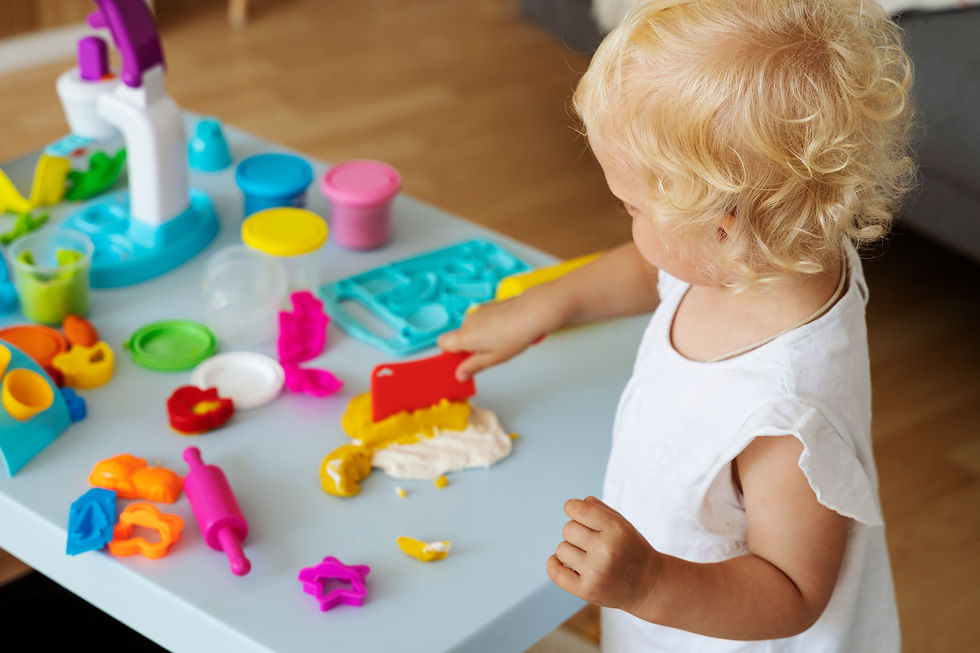
Toddlers take this imitation further, acting out familiar routines like feeding a toy, talking on a pretend phone, or sweeping the floor, just as they have seen you do.
These early pretend play moments are hugely significant.
They help young children begin to make sense of the world around them.
At Lucky Beans Childcare, we support babies in these early imaginative stages just as much as we do with our older toddlers. Recognising that the foundations of imaginative play are rooted very early.
How Lucky Beans Supports Imaginative Play
We have carefully created environments across all of our nurseries that invite children to imagine, explore and create.
This means having:
Inviting play spaces that are warm, well-resourced and thoughtfully arranged,
Open-ended resources such as natural materials, loose parts, and real-life objects that children can use in their own way,
Plenty of time for child-led play, where children follow their own ideas and interests,
Forest-school-inspired approach means children have rich opportunities for imaginative and sensory play outdoors, from den building to story-based exploration,
Caring practitioners who know when to stand back, when to join in and when to gently extend a child's thinking,
A home-from-home atmosphere where children feel safe, settled and free to explore.
Play, Imagine, Thrive
Imaginative play may look simple from the outside, but it plays a significant role in helping young children grow.
It supports language, communication, relationships, emotional well-being, and creativity in ways that feel entirely natural. For children, play is their work.
At Lucky Beans Childcare, we give every child the time, space and support to play, imagine and thrive.
Want to see how children learn through play at Lucky Beans Childcare? Book a tour at your nearest nursery in Balham, Tooting, Streatham or Norbury.


Comments